

Creation of Pulse Flour Ingredients using Roller Milling
As the voice of the Canadian Cereals value chain, Cereals Canada is committed to research and collaborating with partners in agriculture on behalf of the industry.

For the last four-and-a-half years, Lindsey Boyd, a technologist at Cereals Canada, has worked alongside key members of the technical team to develop milling processes that the Canadian pulse industry can use to create a variety of high-quality pulse flour ingredients in a project funded by the Pulse Science Cluster.
The first activity of the project was to determine if roller milling produced pulse flours with different quality attributes compared to flours produced from Ferkar milling. Overall, Boyd found that flours produced from roller milling were brighter and more yellow in colour, had different starch pasting properties, and had more uniform particle size distributions than the flours produced from Ferkar milling.
Optimizing Milling by Using Pre-Treatments
For the second activity of the project, Boyd and the milling team investigated further optimization of roller milling using milling pre-treatments to improve the removal of the hull, which is the outer coating on the pulse seed. The hull can affect the quality of the pulse flour and is traditionally removed through a separate dehulling process prior to milling. This work assessed if scouring (a light abrasion treatment typically used in wheat milling) prior to roller milling pulse seeds on a pilot scale Bühler roller mill could improve hull separation. Boyd found scouring was effective in hull separation for green lentil, yellow pea, and navy bean, but was less effective for Kabuli chickpeas.
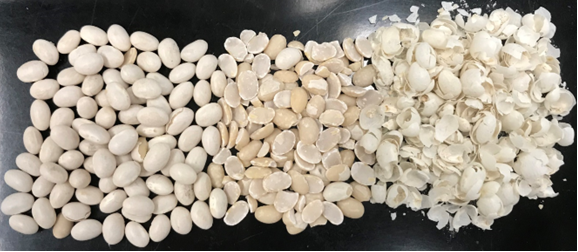
Protein content of the flour streams obtained from the roller mill for each pulse type varied, indicating that a protein gradient exists within the pulse seeds with higher protein material concentrated toward the outer layers of the seed. Compositional differences in the flour streams influenced flour functionality, such as water hydration capacity, starch pasting properties, and colour.
Creating Pulse Flour Ingredients and Using End-products to Assess Suitability

To create different pulse flour ingredients, blends of different flour streams were created. Straight grade (blend of all streams), low protein, and high protein flours were prepared, as well as a whole flour that was made by blending the straight grade flour with remilled hulls that were removed during the roller milling process. Creating a whole pulse flour in this manner provides processors with more control over the amount of hulls to add back into the flour and particle size.
Once the pulse flour ingredients were created, Boyd worked with staff in both the pilot bakery and pasta and extrusion plant at Cereals Canada to produce a variety of products. The team assessed the ingredients for their suitability for use in bread (20% inclusion), spaghetti (30-50% inclusion), and extruded snack products (60-80% inclusion).
Each pulse type and ingredient performed differently in the end-products indicating that some pulse types and/or ingredients are better suited to some applications than others. For example, navy bean flours performed well in bread but did not perform as well in spaghetti and extruded snack applications, while bread made with yellow pea flours had the poorest quality among all pulse flours but performed better in extruded snacks.
Additionally, the pulse flour ingredients also influenced end-product quality. For example, the low protein green lentil flour produced spaghetti with better quality than the other green lentil ingredients. The whole pulse flours produced bread with good quality but had stronger pulse and off-flavours, making them less acceptable.

This activity showed that scouring pulse seeds prior to roller milling is an effective way to aid in hull separation without the need for a separate dehulling step prior to milling and allows various pulse flour ingredients to be created. These pulse ingredients had different compositions and performed differently in various end-products.
For more information on this project, please see Roller Milling Pulses: Milling properties, flour quality and end-product applications. This presentation was made by Ashok Sarkar, Senior Advisor at Cereals Canada, at the International Association of Operative Millers (IAOM) Southeast Asia conference on October 3, 2022.
Some of these results along with results from the project’s other collaborators were published in the following manuscript: Choo, K., Ramachandran, R., Sopiwnyk, E. and Paliwal, J. 2022. Effects of Seed Moisture Conditioning and Mechanical Scouring Pre-Treatments on Roller-Milled Green Lentil (Lens culinaris) and Chickpea (Cicer arietinum) Flours. Food and Process Biotechnology, 15:1311-1326.
This is a collaborative research project between Cereals Canada, Agriculture and Agri-Food Canada, Canadian Grain Commission, University of Saskatchewan, and University of Manitoba on the Development of Processing Strategies for Innovative Commercially Ready Pulse Ingredients for the Canadian Food Sector. Cereals Canada received funding through the Canadian Agricultural Program (CAP) AgriScience Cluster Program.
