
2025 New Wheat Crop Report
In 2025, Canada produced a good quality wheat crop with above-average volumes and yields.

Overall Quality
The majority of wheat grown in 2025 graded No. 1 or No. 2.

How it was Grown
Despite variable growing conditions across the Prairies, timely mid-summer rains supported higher-than-average yields. In eastern Canada, favorable weather throughout the growing season for winter wheat resulted in strong yields and good quality.

Production
In 2025, Canadian farmers grew nearly 40 million tonnes of wheat, with the majority in the top two grades.

Protein
Wheat protein content was comparable to average.

Milling Quality
All wheat classes from the 2025 crop had good test weights and higher than average thousand kernel weights were seen for all Western composites.

Shipping
Canada is expected to export 27.7 million tonnes of wheat to over 80 countries in the 2025-26 crop year.
In-depth Assessment of the 2025 Wheat Crop
CWRS
Canada Western
Red Spring
A hard wheat with high protein content. CWRS has superior milling and baking characteristics resulting in excellent end-product quality.
CWAD
Canada Western Amber Durum
CWAD has high protein content, strong and extensible gluten, and high semolina yields. Its superior yellow colour results in pasta and couscous with excellent colour.
OTHER
Wheat, by Specification
This wheat composite represents the quality that could be expected in a shipment by specification of a medium protein wheat from Western Canada.
CESRW
Canada Eastern Soft Red Winter
CESRW has low protein content making it ideal for various baking applications such as cakes, pastries, cookies, crackers, and biscuits.
GROWING SEASON IN REVIEW
Seeding of spring wheat in Western Canada progressed at an above-average pace due to largely warm and dry weather. The Prairie provinces experienced variable growing conditions throughout the spring and summer with uneven rainfall. However, slightly lower summer temperatures and widespread late-season rainfall supported overall yield potential. Yields exceeded the five-year average, leading to above-average production volumes for both non-durum and durum wheats. This year’s wheat crop is good quality with majority of the production in the top two grades.
2025 Crop Summary
Yields were above average for both non-durum and durum wheat. The 2025 wheat crop is 11 percent larger than last year and 23 percent larger than average. This year, Canada grew nearly 40 million tonnes of wheat.
Canadian wheat had good quality for all classes, with the majority grading No. 1 or No. 2.
- The CWRS crop had high protein with a very high proportion grading No. 1 or No. 2.
- Majority of the 2025 CWAD crop graded No. 1, No. 2 or No. 3. and had good protein content, typical for this class.
- Wheat, by Specification represents a medium protein wheat with a wheat protein content of 12.9%.
- 98% of the CESRW crop graded No. 2 or above, and protein is slightly higher than last year.
2024 Crop Summary
Yields exceeded expectations. The 2024 wheat crop is six percent larger than last year and ten percent larger than average. This year, Canada grew nearly 35 million tonnes of wheat.
Canadian wheat had excellent quality for all classes, with a high proportion of the crop grading No. 2 or better.
- The CWRS crop had average protein content with a very high proportion grading No. 1 or No. 2
- A high proportion of the CWAD crop graded No. 1 or No. 2 and had average to higher-than average protein content.
- The CPSR crop had average protein content, and a very high proportion graded No. 1 or No. 2.
- A high proportion of the CESRW crop graded No. 1 or No. 2 with protein content that is slightly lower than average.
2023 Crop Summary
Following the above-average production volumes in 2022, production in 2023 decreased due to dry growing conditions in large areas of Western Canada. In 2023, Canada grew nearly 32 million tonnes of wheat, a decrease of seven percent from the previous year but consistent with the five-year average.
Canada had excellent quality this year in all wheat classes for the 2023 crop year with the majority grading No. 2 or better and average to higher-than-average protein content.
- Over 95% of the CWRS crop graded No. 1 and No. 2, with average protein content.
- Over 80% of CWAD graded No. 1 and No. 2, with protein content higher than average.
- Over 90% of CPSR graded No. 1 and No. 2, with average protein content
- Over 90% of CESRW graded No. 1 and No. 2, with average protein content.
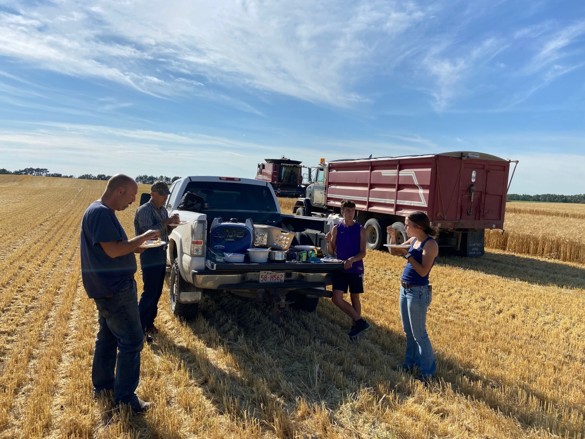
Canada is known for its quality around the world. As Canadian farmers, we are constantly striving for quality.”
— Stewart Oke
Wheat, barley, and oilseed farmer
Delburne, Alberta
01
Growing
The spring wheat growing season started with widespread warm and dry weather across Western Canada, allowing producers to finish seeding ahead of the average pace. Soil moisture levels were generally supportive at the start of the growing season but decreased in many regions throughout June and the first half of July due to below-average, scattered precipitation.
The second half of July brought beneficial rainfall to large parts of the Prairies, particularly along the southern half of the growing region. Timely rains and slightly cooler temperatures helped to protect overall yields, especially in later seeded crops. Yields were higher than average for both non-durum and durum wheats.
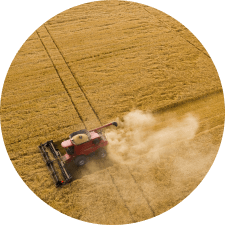
Harvest of spring wheat started behind last year’s pace due to ample rainfall in the first half of August. Drier weather returned to Alberta and western Saskatchewan in the second half of August and throughout September, allowing producers to make rapid harvest progress. In the eastern half of the Prairies, wet conditions persisted into September. Despite delays in many areas, producers across Western Canada worked hard to complete harvest by the first half of October, in line with recent years.
Eastern Canada benefited from an extended planting window in the fall of 2024, leading to a larger seeded area. Timely rainfall helped the crop establish. Winter survival was high thanks to a good snow cover and favourable weather. During the harvest stage, an extended window of dry weather allowed producers to harvest quickly with strong quality.
02
Production
In 2025, Canadian farmers grew nearly 40 million tonnes of wheat, with the majority in the top two grades.
Western Canada produced a crop with above-average volumes and yields. The 2025 wheat crop is 11 percent larger than last year and 23 percent larger than average, thanks to above-average yields for both non-durum wheat and durum wheat.
| ‘000 tonnes | Non-Durum Wheat | Durum Wheat | Total |
| PRODUCTION | 30,089 | 6,535 | 36,624 |
| CARRY-IN | 3,616 | 496 | 4,112 |
| DOMESTIC USE | 7,505 | 736 | 8,241 |
| EXPORTS | 22,300 | 5,100 | 27,400 |
| END STOCKS | 4,000 | 1,200 | 5,200 |
Source: Agriculture and Agri-Food Canada, October 2025

03
Sample Analysis
Western Canada: Cereals Canada worked directly with the grain exporters to obtain commercially representative samples of the 2025 Western Canadian wheat crop.
This year, Cereals Canada received over 130 samples from nine grain exporters. Each company sample represented export quality from a specific region in Western Canada for each wheat class (CWRS, CWAD) and grade. These samples were used to prepare composite samples representative of this year’s crop quality that were analyzed at Cereals Canada.
Eastern and Western composites were prepared for No. 1 CWRS.
Prairie composites were prepared for No. 2 CWRS, CWAD (No. 1, No. 2, No. 3) and Wheat, by Specification.
Cereals Canada staff communicated weekly with individual exporters to gain insight on how harvest was progressing and any relevant downgrading factors that may affect the quality of the 2025 wheat crop.
This is part of Cereals Canada’s commitment to accurately represent the quality of the 2025 wheat crop from Western Canada.
Eastern Canada: The eastern wheat Harvest Assessment was in collaboration with Grain Farmers of Ontario. Grain Farmers of Ontario worked with grain elevators across southern Ontario to collect over 200 samples of CESRW for its annual wheat harvest assessment.
Cereals Canada prepared a composite of a No. 2 or better CESRW from these samples that are representative of the 2025 CESRW crop from Eastern Canada.

04
Shipping
Canada is investing in infrastructure and supply chain improvements to meet global customer needs.
Investments in rail, terminals, and country elevator facilities, made by the Canadian grain supply chain, have increased Canada’s capacity to efficiently move grain to customers around the world. Canada is expected to export 27.7 million tonnes of wheat to over 80 countries in the 2025-26 crop year.