

Pre-Treatment of Pulse Seeds Can Modify Flour Functionality

Working alongside key Cereals Canada technical staff, technologist Lindsey Boyd has been investigating milling processes that the Canadian pulse industry can use to create a variety of high-quality pulse flour ingredients.
The first activity of the project was to determine if roller milling produced pulse flours with different quality attributes compared to flours produced from Ferkar milling.
Next, Boyd and the milling team investigated further optimization of roller milling to improve the removal of the hull, which is the outer layer on the pulse seed.
In the third activity, Boyd and the team examined whether pre-treating the pulse seeds before milling could modify the functionality of the pulse flours and improve the sensory attributes, such as flavour, when used in end-products.
Do pre-treatments affect functionality, appearance, and flavour?
As in the previous activities, Boyd worked with navy beans, green lentils, yellow peas, and kabuli chickpeas. Prior to milling, three different pre-treatments were applied to each pulse type—roasting, germination, and micronization (infrared heat).
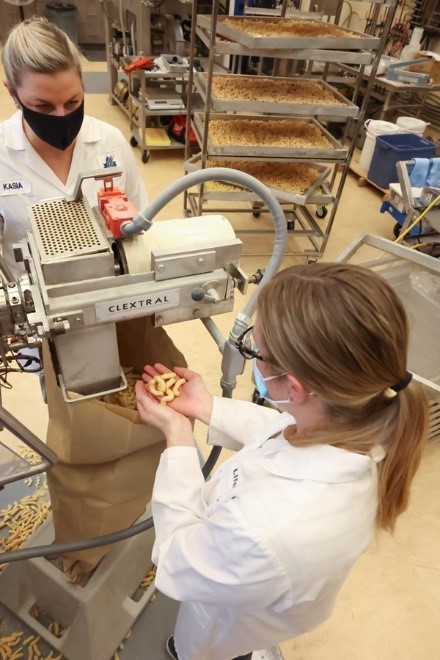
Once treated and milled, the flours were incorporated into bread (20% inclusion, spaghetti (30-50% inclusion) and extruded snacks (60-80% inclusion). The team found that the pulse flour functionality was affected by each pre-treatment.
Effect on Flour Functionality
Flours produced from seeds that were germinated had slightly higher protein contents than the flour that were produced from untreated, roasted and micronized seeds. Flours produced from roasted and micronized seeds were darker and redder, while flours produced from germinated seeds looked brighter and less yellow. Micronization had the greatest impact on functionality as it created high amounts of starch damage which affected other properties such as water hydration capacity and starch pasting properties.

Effect on End-Products
Boyd found that flours produced from germinated seeds performed consistently well in bread, spaghetti, and extruded snack applications. Breads made with germinated flours had high specific volume, good crumb structure and a bright colour. Spaghetti made with flour from germinated seeds had good firmness and cooked texture, and extruded snacks made with flour from germinated seeds had good expansion.
However, depending on pulse type and end-product application, there was different acceptability of the end-products related to their flavour. Flour produced from germinated chickpeas had good processing and texture properties, but an unacceptable flavour profile in all end-product applications tested. Spaghetti made with flour produced from germinated yellow pea and green lentil flours were both preferred based on sensory characteristics, but the same flours were unacceptable when used in bread.
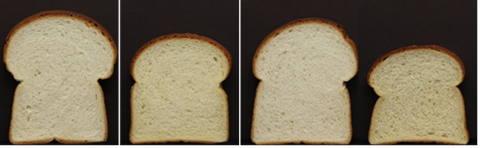
Flours produced from micronized pulses resulted in end-products with good flavour profiles, but with poor quality and would require further optimization in formulation and processing. Breads and spaghetti made with flour from micronized seeds had small loaf volumes and low cooked firmness resulting in a soft texture, respectively.
Extruded snacks made with 80 percent flour produced from roasted yellow pea or green lentil flour showed the most potential to be used in a commercial application as they had good expansion, texture, and flavour. However, regardless of pre-treatment chickpea and navy bean flours, were not suited to the production of extruded snacks for several reasons, including poor expansion, poor texture, and unacceptable flavour profiles.
This activity showed that pre-treatments affected each pulse type differently, which impacted their performance in each end-product. Improvements in end-product quality and sensory attributes were observed in some of the end-products made with pre-treated pulse flours.
Recently, Boyd had the opportunity to present some of these results at the Cereals & Grains 22 conference in Bloomington, Minnesota.
As the voice of the Canadian Cereals value chain, Cereals Canada is committed to research and collaborating with partners in agriculture on behalf of the industry.
This is a collaborative research project between Cereals Canada, Agriculture and Agri-Food Canada, Canadian Grain Commission, University of Saskatchewan and University of Manitoba on the Development of Processing Strategies for Innovative Commercially-Ready Pulse Ingredients for the Canadian Food Sector.
Cereals Canada received funding through the Canadian Agricultural Program (CAP) AgriScience Cluster Program.

